
Let users sign in with Face ID, fingerprint, device PIN, or a hardware security key. VentraConnect adds native WebAuthn Passkey login to supported WordPress login flows — no separate identity platform required.
What are Passkeys?
Passkeys are a modern alternative to passwords. A Passkey is stored securely by the user's device, browser, or password manager. When the user signs in, they confirm their identity using the security method already available on that device.
Depending on the device, this may include:
Device biometrics
Other device methods
Before you begin
Make sure your site meets the following requirements before enabling Passkeys.
Where Passkeys work in VentraConnect Free
VentraConnect Free provides native Passkey support for supported standard WordPress flows. A standard WordPress site can offer Social Login, native Passkeys, Magic Link, and Email OTP without needing a separate authentication service.
Supported flows
Third-party integrations
Enable Passkeys in VentraConnect
To enable Passkeys, follow these steps from your WordPress dashboard.
- Sign in to your WordPress dashboard as an administrator.
- Open the VentraConnect settings area.
- Open the Passkeys tab.
- Enable native Passkeys.
- Save your settings.
How users create their first Passkey
Most users will create their first Passkey from their WordPress profile after signing in to an existing account.
- Sign in to your WordPress account using your password, Social Login, Magic Link, or Email OTP.
- Open your WordPress profile.
- Find the Passkeys section.
- Select the option to add a new Passkey.
- Confirm the browser or device prompt using a fingerprint, Face ID, device PIN, screen lock, or supported security key.
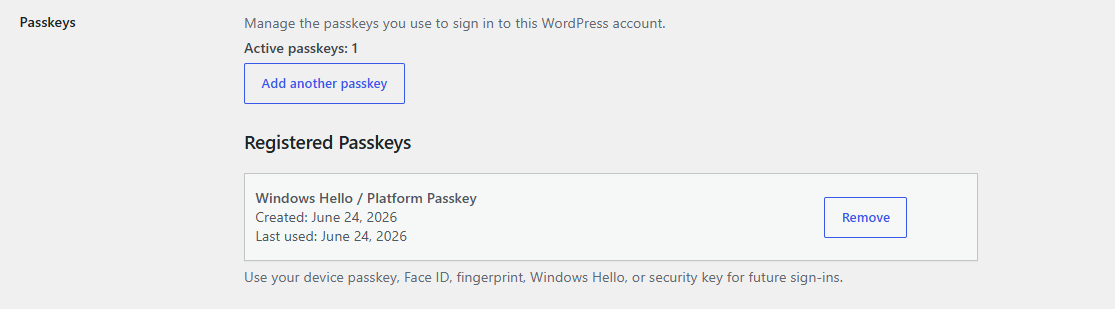
WordPress profile page showing the Add Passkey button
How users sign in with a Passkey
Once a user has registered a Passkey, they can use it to sign in from supported login screens. The exact prompt may look different depending on the browser, device, and password manager being used.
- Open the WordPress login page.
- Select Continue with Passkey.
- Confirm the browser or device prompt.
- Verify using the available security method.
- The user is signed in without entering their password.
Manage Passkeys from the WordPress profile
Logged-in users can manage their Passkeys through the supported WordPress profile experience.
What users can do from their profile
Example: one user, multiple devices
Prompt logged-in users to set up a Passkey
Enabling Passkeys gives users a better way to sign in, but many people will not think to visit their profile and create one. The Floating Passkey Setup Panel helps turn Passkey availability into real adoption by prompting eligible users while they are already signed in and active on your site.
With VentraConnect Pro, you can show a small, configurable setup prompt on selected logged-in pages. It appears only for users who do not yet have a Passkey and gives them a direct path to add one without hunting through account settings.
Turn availability into adoption
Show it where members are active
How the Floating Passkey Setup Panel works
- A logged-in user visits one of the pages you selected in the Passkeys settings.
- VentraConnect checks whether that user already has a Passkey.
- If they do not, the panel appears after the display delay you configured.
- The user selects Set up Passkey and completes the normal browser or device verification prompt.
- After setup, the Passkey is linked to their account and can be used for future sign-ins on supported login flows.
Configure the panel
From the VentraConnect Passkeys settings, you can enable the Floating Passkey Setup Panel and control when, where, and how it appears.
Configure the Floating Passkey Setup Panel from the VentraConnect Passkeys settings.
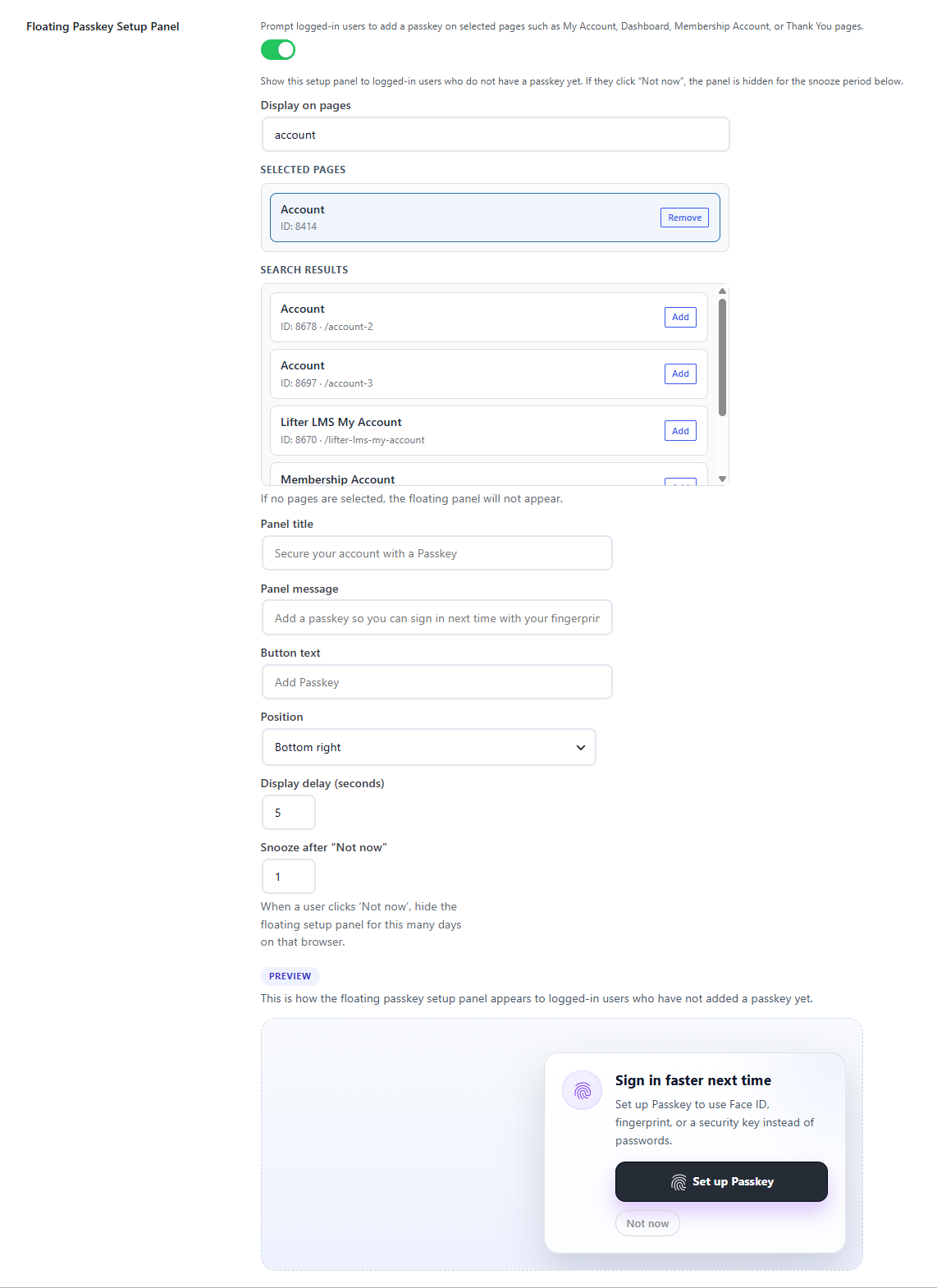
Choose selected pages, customize the panel message and button, set the position and delay, and decide how long “Not now” hides the prompt for that user.
Use Passkeys with Social Login, Magic Link, and Email OTP
Passkeys do not replace the other login methods provided by VentraConnect. Users can continue to sign in using any available method. This gives users a choice and creates a more flexible login experience without forcing every user into one authentication method.
Available login options
Why this matters
Someone who prefers Google login can still use Social Login. Someone without a Passkey can request a Magic Link or Email OTP instead.
For site owners, this creates a modern authentication foundation without needing a separate hosted identity platform.
Use Passkeys on a custom login page
VentraConnect can display supported login methods on custom pages through its shortcode functionality. When you use a standard VentraConnect shortcode login form, native Passkey support can appear there when Passkeys are enabled.
Use case
This is useful when you want to create a custom login page that matches your site design while still offering modern sign-in methods including Passkeys, Social Login, Magic Link, and Email OTP.
Why native Passkeys matter
Many WordPress sites rely on traditional passwords alone. Passwords can be forgotten, reused across websites, entered incorrectly, or exposed through phishing attempts. They also create friction for returning users, especially on mobile devices.
The traditional approach
The modern alternative
Important limitations
VentraConnect Free provides the native Passkey foundation for supported standard WordPress flows. The following placements require VentraConnect Pro.
Troubleshooting
The Passkey option does not appear
Check the following: Passkeys are enabled in VentraConnect settings. Your server runs PHP 8.2 or later. Your website uses HTTPS. You are testing a supported WordPress login, registration, profile, or shortcode flow. Your browser and device support Passkeys. Your login page is not being served from an outdated page cache.
Passkeys are not available in VentraConnect settings
Native Passkeys require PHP 8.2 or later. Check your WordPress hosting environment and update PHP if your server is running an older version. VentraConnect intentionally does not enable native Passkey functionality on unsupported PHP versions.
The browser does not show a Passkey prompt
This usually means the browser, device, device security settings, or password manager does not currently support Passkeys for that user. Ask the user to try a modern browser, a device with a screen lock enabled, a supported password manager, or another device such as a phone or laptop.
No Passkey is found for this account
The user may not have created a Passkey for that account yet. They may also have created the Passkey on another device or saved it in a different password manager. The user can sign in with another available method, then create a Passkey from their WordPress profile.
The user cancelled the Passkey prompt
Cancelling a Passkey prompt does not lock the user out. They can try again or use another available sign-in method such as their WordPress password, Social Login, Magic Link, or Email OTP. They can create a Passkey later after signing in.
My website does not use HTTPS
Passkeys require HTTPS in normal production use. Install a valid SSL certificate and make sure your WordPress Address and Site Address use https://.
Need Passkeys inside WooCommerce or membership flows?
VentraConnect Free provides native Passkeys for standard WordPress login, registration, and profile flows. To place Passkeys inside supported WooCommerce, membership, community, and LMS flows, explore VentraConnect Pro.


